
 Image 1 of 1
SALATHÉ AND CHOUINARD | 1964
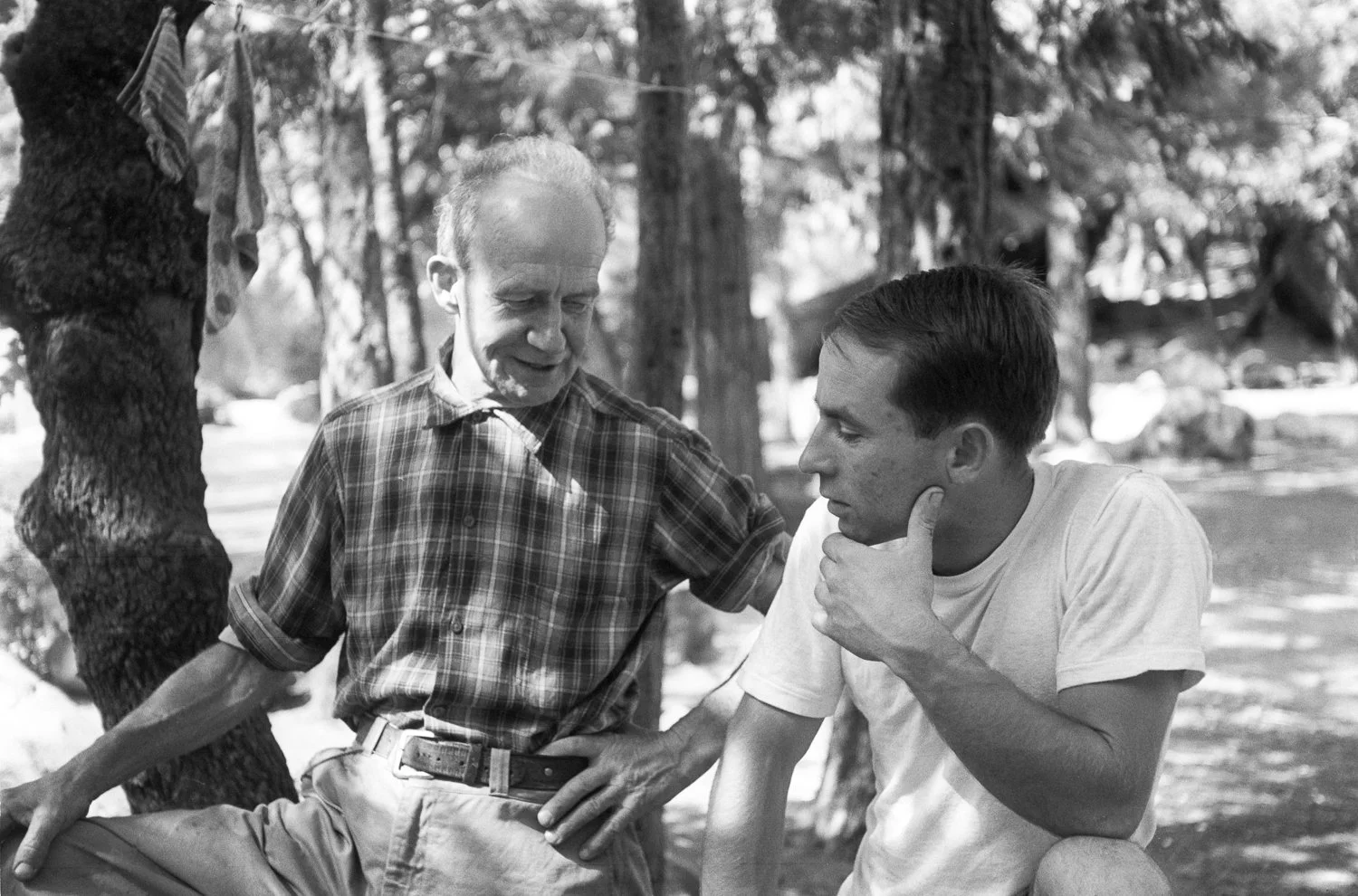
CLICK IMAGE TO VIEW THE FULL PRINTIn the fall of 1964 two great pioneers of American climbing met at Camp 4: a Swiss blacksmith. Both visionaries, able to see the way. Both leaders in their generations – John Salathé and Yvon Chouinard.
Royal wrote about how deeply Salathé’s example influenced us. He said, in addition to Salathé’s great talents and remarkable craftsmanship in forging chromium steel pitons, it was his “sense of style” that would set a standard for generations of climbers to come. In those days bolts were considered a last resort – sometimes a string of them, to overcome truly blank sections of otherwise climbable rock. And even then, it was absolutely necessary, to take the easy way out, rather than screw one’s way up, and with the proper use of a hammer, to drive the piton in without resorting to the detested expansion bolt.
“Amazingly, Salathé never succumbed to this temptation. His bolts were always deemed by later parties justified, because he placed them with great restraint. Robbins did not, in his day, subscribe to this doctrine. No one would have faulted him for placing twice as many bolts. He was a competitor. Why didn’t he do it? How did he get this sense of style? Why did he set these almost impossibly high standards for himself? We don’t know. But we do know that he learned them not from books or words, but from John Salathé. His actions were pure action, and his actions were to us spellbinding and persuasive. American climbing would have been quite different had not been for Salathé’s influence. I have not been so deeply impressed by the courage and commitment to excellence of this thoughtful, taciturn, Swiss blacksmith who came to California and taught.”
Americans a thing or two about climbing, and on whose shoulders so many of us have stood, reaching for higher holds.” (Royal Robbins, Voices from the Summit)
Writing about John Salathé and the Lost Arrow chimney climb they did together, Anton Nelson said: “Salathé’s strength came not from egoism or pride. Yes, most of us who climb usually play to the crowd, as such an article as this may demonstrate. But Salathé was different. To him the climb was the point. To keep going day after day under heart-sickening strenuousness requires a bigger, more profound belief than any concept of superiority.” (Sierra Club Bulletin, 1948)
Salathé possessed a sensitivity and strength beyond what the rest of us normally apply to life. For example, he listened to the council of his body, and the mountain. He possessed the most valuable attribute a traditional climber can possess – he knew things he didn’t know. Salathé made the impossible possible. He was a kind of “father” of Yosemite rock climbing.
One decade later Yvon Chouinard also saw the need for improved pitons, and an inspiring standard in American wall climbing. Chouinard’s Lost Arrow pitons were patterned after John Salathé’s and his Muir Wall set a new standard on El Capitan.
SALATHÉ AND CHOUINARD, Camp 4, Yosemite Valley, California, October 1964.
Photo: Tom Frost
CLICK IMAGE TO VIEW THE FULL PRINTIn the fall of 1964 two great pioneers of American climbing met at Camp 4: a Swiss blacksmith. Both visionaries, able to see the way. Both leaders in their generations – John Salathé and Yvon Chouinard.
Royal wrote about how deeply Salathé’s example influenced us. He said, in addition to Salathé’s great talents and remarkable craftsmanship in forging chromium steel pitons, it was his “sense of style” that would set a standard for generations of climbers to come. In those days bolts were considered a last resort – sometimes a string of them, to overcome truly blank sections of otherwise climbable rock. And even then, it was absolutely necessary, to take the easy way out, rather than screw one’s way up, and with the proper use of a hammer, to drive the piton in without resorting to the detested expansion bolt.
“Amazingly, Salathé never succumbed to this temptation. His bolts were always deemed by later parties justified, because he placed them with great restraint. Robbins did not, in his day, subscribe to this doctrine. No one would have faulted him for placing twice as many bolts. He was a competitor. Why didn’t he do it? How did he get this sense of style? Why did he set these almost impossibly high standards for himself? We don’t know. But we do know that he learned them not from books or words, but from John Salathé. His actions were pure action, and his actions were to us spellbinding and persuasive. American climbing would have been quite different had not been for Salathé’s influence. I have not been so deeply impressed by the courage and commitment to excellence of this thoughtful, taciturn, Swiss blacksmith who came to California and taught.”
Americans a thing or two about climbing, and on whose shoulders so many of us have stood, reaching for higher holds.” (Royal Robbins, Voices from the Summit)
Writing about John Salathé and the Lost Arrow chimney climb they did together, Anton Nelson said: “Salathé’s strength came not from egoism or pride. Yes, most of us who climb usually play to the crowd, as such an article as this may demonstrate. But Salathé was different. To him the climb was the point. To keep going day after day under heart-sickening strenuousness requires a bigger, more profound belief than any concept of superiority.” (Sierra Club Bulletin, 1948)
Salathé possessed a sensitivity and strength beyond what the rest of us normally apply to life. For example, he listened to the council of his body, and the mountain. He possessed the most valuable attribute a traditional climber can possess – he knew things he didn’t know. Salathé made the impossible possible. He was a kind of “father” of Yosemite rock climbing.
One decade later Yvon Chouinard also saw the need for improved pitons, and an inspiring standard in American wall climbing. Chouinard’s Lost Arrow pitons were patterned after John Salathé’s and his Muir Wall set a new standard on El Capitan.
SALATHÉ AND CHOUINARD, Camp 4, Yosemite Valley, California, October 1964.
Photo: Tom Frost