
 Image 1 of 1
PREPARING FOR THE NOSE | 1960
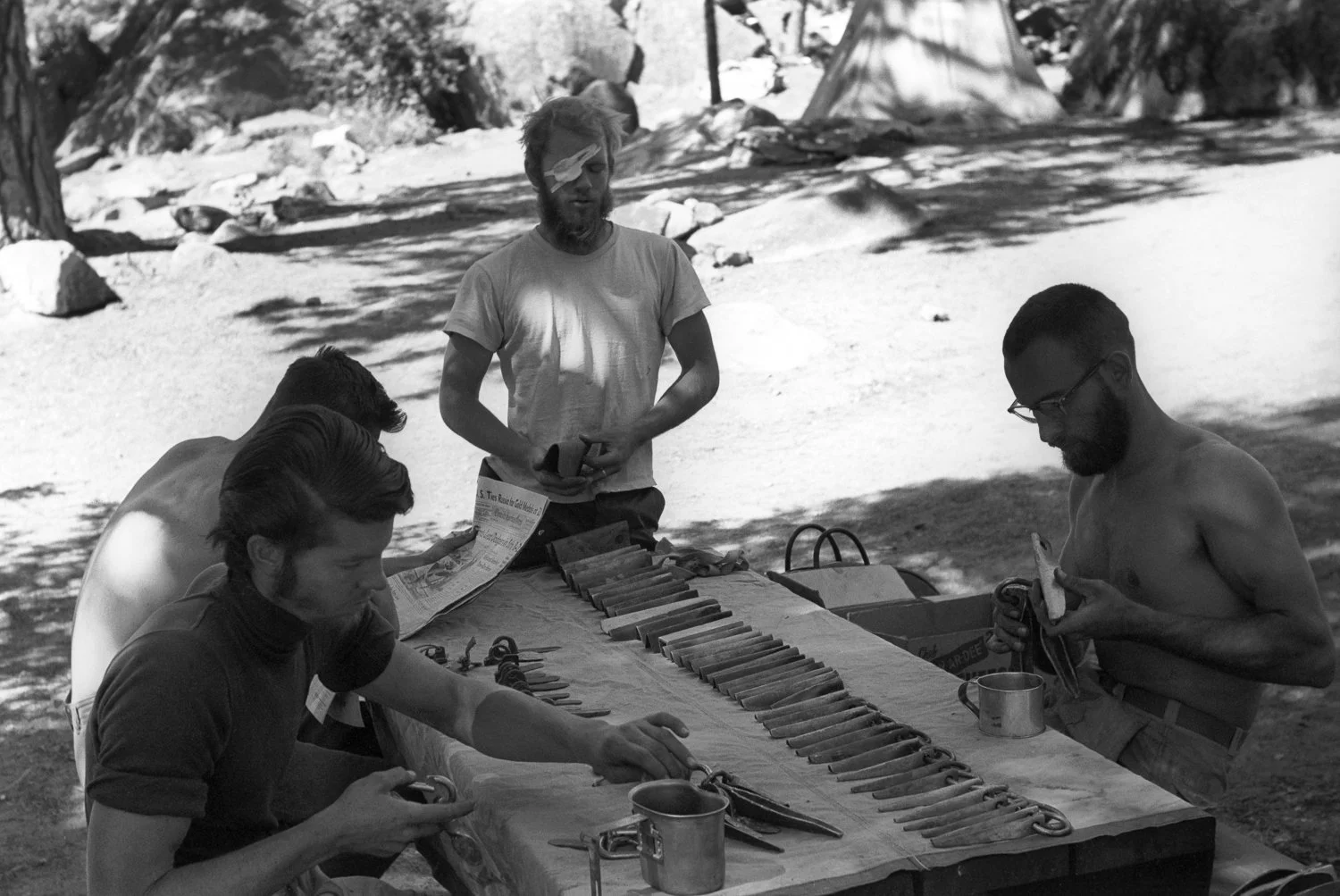
Click image to view the full printThe final preparation to climb El Capitan was to gather the party’s hardware together into one selection. Here, at the Camp 4 table, the climbing team lays out the pitons and carabiners that will be carried on the second ascent of the Nose in September, 1960. These include: knifeblades, hand-forged Lost Arrows, Bugaboos, standard ring angles, and Bongs to 4 inches. Most of these pitons were handmade by Chouinard from tough 4130 steel and 7075 aluminum. On this climb alone many of them would be placed 30 times or more. The hardware was supplemented by the requisite camp equipment: ropes, which were 60 quarts of water, chocolate, salami, cheese, gorp, and bivouac gear. It was an exciting moment.
If successful, this would be the first continuous ascent of El Capitan.
Royal and Liz Robbins describe this place, Camp 4, the campground that served as a launch pad for our climbs and, I believe, also for our lives.
Camp 4 is situated on the north side of the road just across from Yosemite Lodge. It is, and always was, a scruffy place. When we first went there, in the early 1950s, it was already the climbers’ camp, a spot dotted with large boulders and with campsites in irregular places. I guess the Park Service thought it was good enough for climbers. They were right. We loved the boulders and the campsites, and if we didn’t like it we could leave, but we would find a way to stay. There was a big table for climbers to congregate, share ideas, and make plans. Camp 4 was our “home,” our refuge from the “world out there.” The 1960s were a time of great upheaval in society, with war, protests and universities shut down. But we climbers mostly ignored it. We concentrated on the walls of Yosemite and other areas of the West. We were building our lives around climbing, philosophy, general, and of course, our next climb. (Royal Robbins, Damon Robbins, Camp 4 restaurant menu, Modesto, CA)
Sometimes things that make no sense on the surface make perfect sense inside. At first Camp 4 was just a dusty landscape: cluttered tables, dirty tents, people coming and going. Yet something there seemed to hum with a raw, unselfconscious energy. I was somehow drawn in. I didn’t know why. Here, individuals were what they were, like it or not. When someone asked me if I wanted to go on a little climb, I said yes. Initially Royal Robbins reminded me of a Berkeley professor. After climbing with him on Cathedral Peak, I realized this aloof, quiet, contemplative man had a deep warmth and humor. It was a combination I had not encountered before. I was inspired to take up climbing in earnest. I had never imagined a need that would drive him to make ascents other people couldn’t comprehend. Climbing was new to me, but the integrity underlying Royal’s pursuits was something I knew I could rely upon in any circumstance. To the bewilderment of my family and friends back home, I adopted his eccentric-seeming way of life. (Liz Robbins, Alpinist 23, Spring 08)
PREPARING FOR THE NOSE, Robbins, Pratt, and Fritschen sort hardware for the Nose of El Capitan, Yosemite Valley, California, second ascent, seven days, September 1960, by Royal Robbins, Chuck Pratt, Joe Fitschen, and Tom Frost.
Photo: Tom Frost
Click image to view the full printThe final preparation to climb El Capitan was to gather the party’s hardware together into one selection. Here, at the Camp 4 table, the climbing team lays out the pitons and carabiners that will be carried on the second ascent of the Nose in September, 1960. These include: knifeblades, hand-forged Lost Arrows, Bugaboos, standard ring angles, and Bongs to 4 inches. Most of these pitons were handmade by Chouinard from tough 4130 steel and 7075 aluminum. On this climb alone many of them would be placed 30 times or more. The hardware was supplemented by the requisite camp equipment: ropes, which were 60 quarts of water, chocolate, salami, cheese, gorp, and bivouac gear. It was an exciting moment.
If successful, this would be the first continuous ascent of El Capitan.
Royal and Liz Robbins describe this place, Camp 4, the campground that served as a launch pad for our climbs and, I believe, also for our lives.
Camp 4 is situated on the north side of the road just across from Yosemite Lodge. It is, and always was, a scruffy place. When we first went there, in the early 1950s, it was already the climbers’ camp, a spot dotted with large boulders and with campsites in irregular places. I guess the Park Service thought it was good enough for climbers. They were right. We loved the boulders and the campsites, and if we didn’t like it we could leave, but we would find a way to stay. There was a big table for climbers to congregate, share ideas, and make plans. Camp 4 was our “home,” our refuge from the “world out there.” The 1960s were a time of great upheaval in society, with war, protests and universities shut down. But we climbers mostly ignored it. We concentrated on the walls of Yosemite and other areas of the West. We were building our lives around climbing, philosophy, general, and of course, our next climb. (Royal Robbins, Damon Robbins, Camp 4 restaurant menu, Modesto, CA)
Sometimes things that make no sense on the surface make perfect sense inside. At first Camp 4 was just a dusty landscape: cluttered tables, dirty tents, people coming and going. Yet something there seemed to hum with a raw, unselfconscious energy. I was somehow drawn in. I didn’t know why. Here, individuals were what they were, like it or not. When someone asked me if I wanted to go on a little climb, I said yes. Initially Royal Robbins reminded me of a Berkeley professor. After climbing with him on Cathedral Peak, I realized this aloof, quiet, contemplative man had a deep warmth and humor. It was a combination I had not encountered before. I was inspired to take up climbing in earnest. I had never imagined a need that would drive him to make ascents other people couldn’t comprehend. Climbing was new to me, but the integrity underlying Royal’s pursuits was something I knew I could rely upon in any circumstance. To the bewilderment of my family and friends back home, I adopted his eccentric-seeming way of life. (Liz Robbins, Alpinist 23, Spring 08)
PREPARING FOR THE NOSE, Robbins, Pratt, and Fritschen sort hardware for the Nose of El Capitan, Yosemite Valley, California, second ascent, seven days, September 1960, by Royal Robbins, Chuck Pratt, Joe Fitschen, and Tom Frost.
Photo: Tom Frost