
 Image 1 of 1
Click image to view the full printSteve Roper reported on Warren Harding’s first ascent of the Nose in his book Camp 4:
On day seven the team encountered the feature that came to be known as the Stoveleg Crack, a 300-foot series of two-to-three-inch-wide slits on the eighty-degree wall. Fortunately, Harding had spotted this landmark from the ground and had brought along several specialty pitons, ones acquired in a strange way. During the fall of 1956, Frank Tarver decided to search a local dump for old angle-iron stock from which to fashion wide-angle pitons. Working his way through a labyrinth of old bedsprings and rusting appliances, Tarver spied four enameled stovelegs, separated from an old-fashioned stove. Buying these for a song, he and a friend smashed one end of each U-shaped leg and brazed the flattened section. Next, they drilled a hole through the steel and attached a ring. Voilà! A sizable angle piton was born. Nine inches long, and wide enough to fit cracks between two and three inches, the device weighed fifteen ounces. Naturally, the metallurgical qualities of this gadget were suspect, but it would obviously work – and that was what mattered.
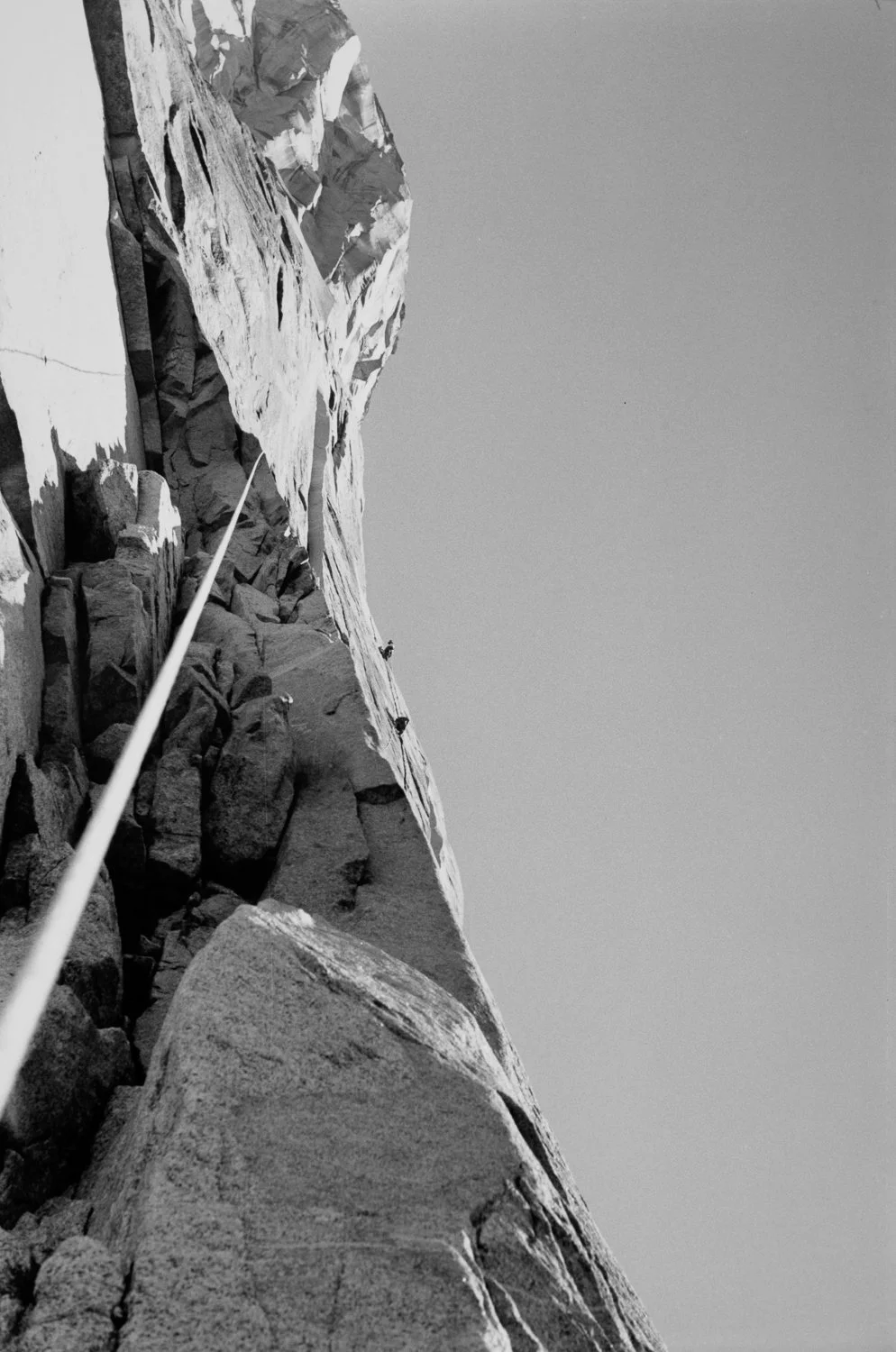
Equipped with modern, larger angle pitons, Royal Robbins and Joe Fitschen ascend these classic pitches during the second ascent of El Capitan in September 1960. Well below them Chuck Pratt and Tom Frost address the heavy problem of moving our four 50 pound haul bags the 700 vertical feet from Sickle Ledge up to Dolt Tower. It was an adventure filled day.
IN THE STOVE LEG CRACK, Robbins and Fitschen at work during the second ascent of the Nose, El Capitan, Yosemite National Park, September 1960.
Photo: Tom Frost
Click image to view the full printSteve Roper reported on Warren Harding’s first ascent of the Nose in his book Camp 4:
On day seven the team encountered the feature that came to be known as the Stoveleg Crack, a 300-foot series of two-to-three-inch-wide slits on the eighty-degree wall. Fortunately, Harding had spotted this landmark from the ground and had brought along several specialty pitons, ones acquired in a strange way. During the fall of 1956, Frank Tarver decided to search a local dump for old angle-iron stock from which to fashion wide-angle pitons. Working his way through a labyrinth of old bedsprings and rusting appliances, Tarver spied four enameled stovelegs, separated from an old-fashioned stove. Buying these for a song, he and a friend smashed one end of each U-shaped leg and brazed the flattened section. Next, they drilled a hole through the steel and attached a ring. Voilà! A sizable angle piton was born. Nine inches long, and wide enough to fit cracks between two and three inches, the device weighed fifteen ounces. Naturally, the metallurgical qualities of this gadget were suspect, but it would obviously work – and that was what mattered.
Equipped with modern, larger angle pitons, Royal Robbins and Joe Fitschen ascend these classic pitches during the second ascent of El Capitan in September 1960. Well below them Chuck Pratt and Tom Frost address the heavy problem of moving our four 50 pound haul bags the 700 vertical feet from Sickle Ledge up to Dolt Tower. It was an adventure filled day.
IN THE STOVE LEG CRACK, Robbins and Fitschen at work during the second ascent of the Nose, El Capitan, Yosemite National Park, September 1960.
Photo: Tom Frost