
 Image 1 of 1
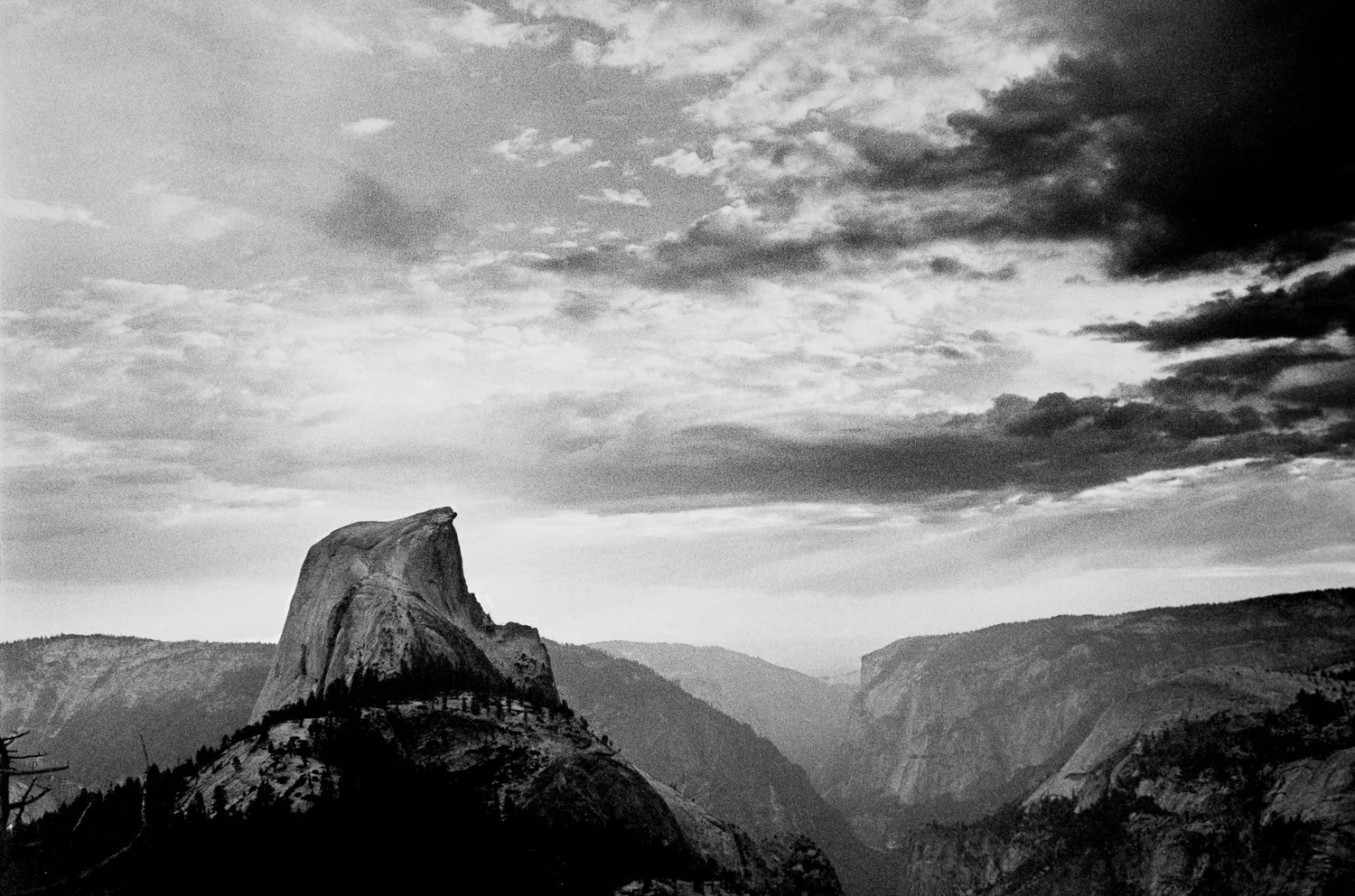
CLICK IMAGE TO VIEW THE FULL PRINTHalf Dome is one of the most recognizable features of Yosemite National Park. Rising nearly 5,000 feet above the Valley floor, its sheer northwest face presents a vast expanse of smooth granite, while its rounded summit dominates the eastern skyline of Yosemite Valley.
The formation has long captured the imagination of visitors, climbers, and writers. From early explorations in the nineteenth century to modern ascents, Half Dome has remained a central symbol of Yosemite’s grandeur and scale.
Approaching Half Dome, one becomes aware of its changing character. From the Valley floor, it appears distant and monumental. From higher vantage points, its form becomes more defined, revealing the sweeping curve of its face and the sharp line of its crest.
Light plays a defining role in the experience of Half Dome. At sunrise and sunset, the granite surface shifts in tone, reflecting the changing sky and emphasizing the structure of the rock. These moments reveal both the simplicity and complexity of the formation.
For those who spend time in Yosemite, Half Dome becomes more than a landmark. It is a constant presence, a point of reference, and a reminder of the enduring relationship between landscape and experience.
HALF DOME, Yosemite National Park, California, 1977.
Photo: Tom Frost
CLICK IMAGE TO VIEW THE FULL PRINTHalf Dome is one of the most recognizable features of Yosemite National Park. Rising nearly 5,000 feet above the Valley floor, its sheer northwest face presents a vast expanse of smooth granite, while its rounded summit dominates the eastern skyline of Yosemite Valley.
The formation has long captured the imagination of visitors, climbers, and writers. From early explorations in the nineteenth century to modern ascents, Half Dome has remained a central symbol of Yosemite’s grandeur and scale.
Approaching Half Dome, one becomes aware of its changing character. From the Valley floor, it appears distant and monumental. From higher vantage points, its form becomes more defined, revealing the sweeping curve of its face and the sharp line of its crest.
Light plays a defining role in the experience of Half Dome. At sunrise and sunset, the granite surface shifts in tone, reflecting the changing sky and emphasizing the structure of the rock. These moments reveal both the simplicity and complexity of the formation.
For those who spend time in Yosemite, Half Dome becomes more than a landmark. It is a constant presence, a point of reference, and a reminder of the enduring relationship between landscape and experience.
HALF DOME, Yosemite National Park, California, 1977.
Photo: Tom Frost