
 Image 1 of 1
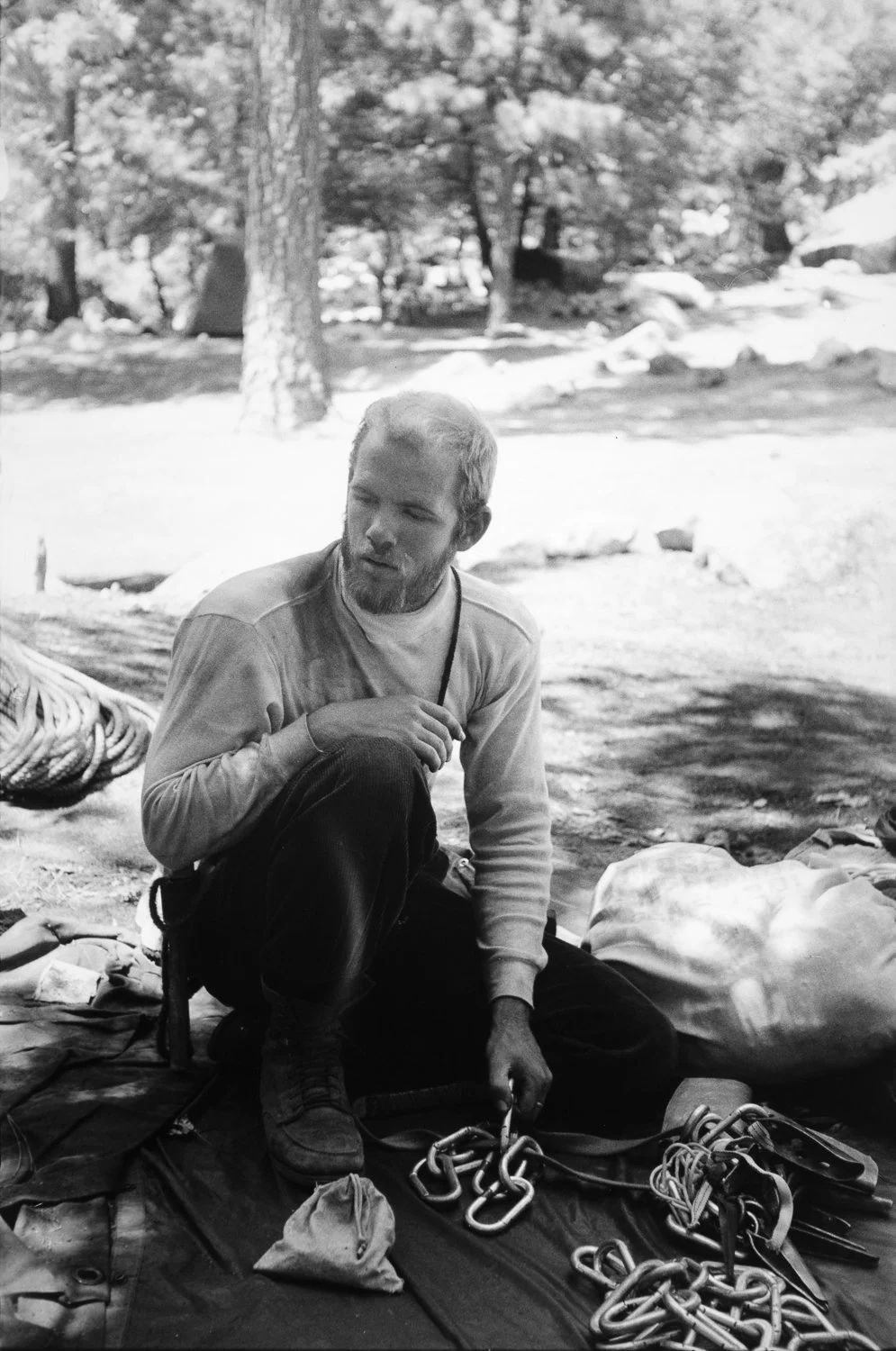
CHUCK PRATT | 1961
CLICK IMAGE TO VIEW THE FULL PRINT“One day in July 1964, Harding showed up with a photo of a huge unclimbed wall, one Pratt had trouble recognizing. The south face of Mount Watkins, 2,000 feet high, lay hidden in Tenaya Canyon, invisible from the standard viewpoints. Harding quickly talked Pratt into an attempt; a few days later the pair corralled an eager Chouinard in Camp 4.
“The five-day climb of Watkins was notable for several reasons. Three of the most famous Valley cragrats of the sixties – Robbins called them ‘the great triumvirate of Yosemite Little Men’ – climbed together only this one time. Also, the trio used no fixed ropes. Robbins later regarded the climb as symbolic of a new age: the permanent end of Yosemite siege climbing. Finally, Pratt wrote a memorable article for the 1965 American Alpine Journal.” (Steve Roper, Camp 4)
Yvon, resorting one last time to rurps and knife-blades, tapped his way to the crest of Mount Watkins just as the sun went down. His triumphant shout told me what we had all waited five days to hear. When Warren reached the ledge, he asked to clean the last pitch as he felt that he had not contributed enough that day! Warren Harding, who had been the original inspiration for the climb, whose determination had gotten us over the headwall below and who had sacrificed his ration of water after five days of intense thirst, felt that he had not done enough! I passed him the rope, and as he began cleaning the last pitch of the climb, I settled down on the ledge to my thoughts.
In the vanishing twilight, the valley of the Yosemite seemed to me more beautiful than I had ever seen it, more serene than I had ever known it before. For five days the south face of Mount Watkins had dominated each of our lives as only nature can dominate the lives of men. With the struggle over and our goal achieved I was conscious of an inner calm which I had experienced only on El Capitan. I thought of my incomparable friend, Chouinard, and of our unique friendship, a friendship now shared with Warren, for we were united by a bond far stronger and more lasting than any we could find in the world below. I wondered what thoughts were passing through the minds of my companions during the final moments.
My own thoughts rambled back through the entire history of Yosemite climbing – from that indomitable Scotsman Anderson, who first climbed Half Dome, to John Salathé, whose philosophy and climbing ethics have dominated Yosemite climbing for nearly twenty years, to Mark Powell, Salathé’s successor, who showed us all that climbing can be a way of life and a basis for a philosophy. These men, like ourselves, had come to the Valley of Light with a restless spirit and the desire to share an adventure with their comrades. We had come as strangers, full of apprehension and doubt. Having given all we had to the climb, we had been enriched by a physical and spiritual experience few men can know. Having accepted the hardships as a natural consequence of our endeavor, we were rewarded by a gift of victory and fulfillment for which we would be forever grateful. It was for this that each of us had come to Yosemite, and it was for this that we would return, season after season. (CP, 1965 AAJ)
And, thus it is.
CHUCK PRATT, Camp 4, Yosemite Valley, California, June 1961.
Photo: Tom Frost
CLICK IMAGE TO VIEW THE FULL PRINT“One day in July 1964, Harding showed up with a photo of a huge unclimbed wall, one Pratt had trouble recognizing. The south face of Mount Watkins, 2,000 feet high, lay hidden in Tenaya Canyon, invisible from the standard viewpoints. Harding quickly talked Pratt into an attempt; a few days later the pair corralled an eager Chouinard in Camp 4.
“The five-day climb of Watkins was notable for several reasons. Three of the most famous Valley cragrats of the sixties – Robbins called them ‘the great triumvirate of Yosemite Little Men’ – climbed together only this one time. Also, the trio used no fixed ropes. Robbins later regarded the climb as symbolic of a new age: the permanent end of Yosemite siege climbing. Finally, Pratt wrote a memorable article for the 1965 American Alpine Journal.” (Steve Roper, Camp 4)
Yvon, resorting one last time to rurps and knife-blades, tapped his way to the crest of Mount Watkins just as the sun went down. His triumphant shout told me what we had all waited five days to hear. When Warren reached the ledge, he asked to clean the last pitch as he felt that he had not contributed enough that day! Warren Harding, who had been the original inspiration for the climb, whose determination had gotten us over the headwall below and who had sacrificed his ration of water after five days of intense thirst, felt that he had not done enough! I passed him the rope, and as he began cleaning the last pitch of the climb, I settled down on the ledge to my thoughts.
In the vanishing twilight, the valley of the Yosemite seemed to me more beautiful than I had ever seen it, more serene than I had ever known it before. For five days the south face of Mount Watkins had dominated each of our lives as only nature can dominate the lives of men. With the struggle over and our goal achieved I was conscious of an inner calm which I had experienced only on El Capitan. I thought of my incomparable friend, Chouinard, and of our unique friendship, a friendship now shared with Warren, for we were united by a bond far stronger and more lasting than any we could find in the world below. I wondered what thoughts were passing through the minds of my companions during the final moments.
My own thoughts rambled back through the entire history of Yosemite climbing – from that indomitable Scotsman Anderson, who first climbed Half Dome, to John Salathé, whose philosophy and climbing ethics have dominated Yosemite climbing for nearly twenty years, to Mark Powell, Salathé’s successor, who showed us all that climbing can be a way of life and a basis for a philosophy. These men, like ourselves, had come to the Valley of Light with a restless spirit and the desire to share an adventure with their comrades. We had come as strangers, full of apprehension and doubt. Having given all we had to the climb, we had been enriched by a physical and spiritual experience few men can know. Having accepted the hardships as a natural consequence of our endeavor, we were rewarded by a gift of victory and fulfillment for which we would be forever grateful. It was for this that each of us had come to Yosemite, and it was for this that we would return, season after season. (CP, 1965 AAJ)
And, thus it is.
CHUCK PRATT, Camp 4, Yosemite Valley, California, June 1961.
Photo: Tom Frost